Tuesday, October 10, 2023

5 spooky Halloween videos for students of all ages

From eSchoolNews:

It’s October, and for many students, that means pumpkins, scary decorations, and trick-or-treating on Halloween. What better way to celebrate October than to incorporate some fun and spooky videos to engage students, while also teaching them some fun facts?

Teachers with students of all ages can use TED-Ed Lessons to leverage October’s fun events (Friday the 13th in October, anyone?) and speak to students’ different interests.

The TED-Ed platform lets educators build lessons around any TED-Ed Original, TED Talk, or YouTube video. Once teachers find the video they want to use, they can use the TED-Ed Lessons editor to add questions, discussion prompts, and additional resources.

Use these TED-Ed Lessons and videos for brain breaks, to introduce new lessons, or to give students some fun and age-appropriate spooky experiences into your classroom:

1. Where do superstitions come from? Are you afraid of black cats? Would you open an umbrella indoors? How do you feel about the number 13? Whether or not you believe in them, you’re probably familiar with a few of these superstitions. But where did they come from? Stuart Vyse shares the weird and specific origins of some of our favorite superstitions.

2. Why is being scared so fun? At this very moment, people are lining up somewhere to scare themselves, be it with a thrill-ride or a horror movie. In fact, in October of 2015 alone, about 28 million people visited a haunted house in the US. But you might wonder: What could possibly be fun about being scared? Margee Kerr examines the biology and psychology behind what makes fear so fun.

3. The fascinating history of cemeteries: Spindly trees, rusted gates, crumbling stone, a solitary mourner: these things come to mind when we think of cemeteries. But not long ago, many burial grounds were lively places, with gardens and crowds of people — and for much of human history, we didn’t bury our dead at all. How did cemeteries become what they are today? Keith Eggener delves into our ever-evolving rituals for honoring the dead.

4. What can you learn from ancient skeletons? Ancient skeletons can tell us a great deal about the past, including the age, gender and even the social status of its former owner. But how can we know all of these details simply by examining some old, soil-caked bones? Farnaz Khatibi examines a fascinating branch of science known as biological anthropology.

5. A video that terrifies while it teaches? There’s a TED-Ed Lesson for that: Pick your poison: Blood hungry vampires. Zombies on a mission for your tasty brain. Creepy crawlies. No matter your (fictional or real) fright of choice, TED-Ed has a lesson for all of your Halloween needs. So pick out your favorite candy (more on that later), choose a few videos, and have a very happy Halloween.

For more on this article and to read more education oriented article click below: 

Use these fun Halloween-themed videos to engage students in classroom learning and capture their attention


Brought to your attention by: Friends@OISE2021

Misbehaviour in School - What can you do?


What to Do About Increasing Dysregulation in the Early Grades

Conflict at school is a normal part of learning how to interact with others—and early-grade teachers have always had to manage misbehavior in class. But not at the levels they’re seeing now.

Sarah Gonser

Want to read more about this, click here >>>>> Dysregulation


Friends@NUO21

Saturday, October 7, 2023

Thanksgiving Wreathe Art

It is an excellent activity for grade 3 for Thanksgiving. Kids will write what they are thankful for in their draft paper and write a short paragraph on their script book. Kids will trace two different leaves eight times on construction paper. In this activity, students will focus on what they're grateful for all year.

    
Courtesy of GhadaN@NU

Wednesday, October 4, 2023

The Importance of Educational Assistants

On a daily occurrence, Educational Assistants (EA's) experience an array of support, demise, and struggle. With the ongoing lack of financial resources, materials within schools, and understanding from Ontario Certified Teacher's, it has become evidently clear that Educational Assistants play a vital role within the classroom. Though there is lack of recognition for the overall job, special education, and the aid required by children with exceptional needs and their families, the classroom would not be able to function without them. EA's work tirelessly ensuring the safety, health, and well-being of the children they support is at the heart of their day. Parallel to creating safe spaces, EA's take the brunt of physical actions and specialize in co-creating and working alongside the classroom teacher to construct Individualized Education Plans (IEPs), Safety Plans, share observations, and the list could go on and on.

As there is now conversation and speculation that there will be a job action movement for many Union's that include Educational Assistants, it is only appropriate that we stand behind them. For the money Educational Assistants make for the work that they do and their role in education, the physical, mental, and emotional toll the job has on them, the high number of medical leaves due to injury on site and stress leaves due to lack of support in all aspects of the job, this seems like the only chance they will have for anything. 


Editor's note - Read the article here:


To all fellow EA's, you are not alone in the feelings that surround the amazing work that you do! 

Please know you are appreciated and valued!


By: SarahP@NU

Learning about Personal Space and Boundaries

Do your students have a hard time understanding about personal space and boundaries? Sometimes they forget to use kind words to tell their friend or classmate that they need more space in between.  Constantly reminding students to use kind words instead of their hands. Here's a fun catchy song we introduced to our classroom for students to understand personal space and Boundaries.


https://www.youtube.com/watch?v=aSFvJbSQdA4


Brought to you by: MichelleG@NU 


Importance of a Visual Schedule in a Classroom

This blog post is to discuss the importance and the benefits of using visual schedules in your classroom. A visual schedule helps set out the daily routines for all students in an easy and comprehensive way for most students. They are also an asset for those who work with or teach children with exceptionalities.


The benefits of a visual schedule:


1.     Helps students see upcoming events and activities through visuals.

2.     It helps maintain routines and expectations. Students will have an understanding of what is happening or expected during that given time.

3.     Helpful for students with exceptionalities. The schedule should be clear and predictable

4.     It can ease transition

5.     Available for children to gain independence and reference throughout the day.

6.     Reinforces words to pictures. For students who may be nonverbal this is a way to create those connections.


These are only some of the benefits of visual schedules in the classrooms for all students and even the educator. Who doesn't enjoy seeing how far down the schedule we have made it?!


There are tons of resources that are premade or that you can custom to fit the needs for your class.


Courtesy of TirezaM@NU


Editor's note:  Check this out >>>>> The Power of Visual Schedules

Behaviour & Mental Health

Let's talk it over….


What is Behaviour & Mental Health?


Mental health is concerned with your psychological state and what makes you unique. Behavioural health addresses how mental health influences particular behaviours, but it also considers how action impacts physical and psychological well-being. Overall, developing one commonly improves the other.

Childhood Mental Health Treatment Challenges

Childhood growth normally entails change, making mental health illnesses in children hard to grasp. A child's condition symptoms may vary with age, and they may not be able to express how they feel or behave. Some other issues may hinder parents from getting treatment for a child with a suspected mental condition. Parents may worry about mental illness stigma, medication use, and treatment cost or logistics.

How can families help their child manage mental illness?

·       Consider family counselling that involves everyone.

·       Ask health care professionals to advise on how to address tough behaviour.

·       Learn stress management skills to keep calm.

·       Relax and play with your child (ren).

·       Praise your child's skills.

·       Work with your child's school for support.


                                                          https://www.youtube.com/watch?v=49mfPFTZsHs


FrancineV@NU

Monday, October 2, 2023

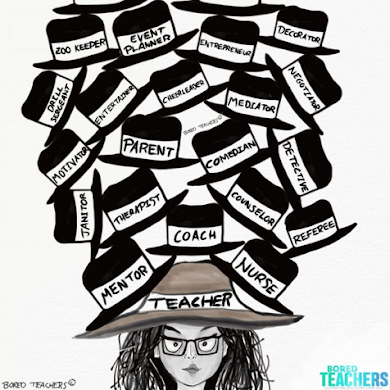
The Many Hats We Wear

It wasn't until recently that I had the opportunity to acknowledge the many roles that a teacher plays in the lives of their students, their families, as well as the educators that surround them. It goes without saying that teachers in the classroom are looked up to by their students, needed in many roles that are far outside of "just education". 


How many teachers/educators have been called "mom" while sitting beside, or are on the other end of a classroom? I can tell you that there have been many who have shared this experience.


As a teacher, it is not only the grades, the report cards, the lesson planning, and the daily schedule that we are to follow, or the rules imposed by our certification that we are to follow. We create learning opportunities for these strong, curious, and independent individuals that call us teacher. Outside of this, we take them on field trips to enhance their knowledge, we meet with families and create environments that feel like home. We follow the interests of the children in our rooms, and we use their inquiry to support their learning. We motivate their learning, but most importantly, we strive to mold and shape individuals that will one day rule the world!


TirezaM@NU


Editor's note:  Check this out >>>>>> https://blog.edpuzzle.com/teacher-life/hats-a-teacher-wears/


Sunday, October 1, 2023

Is There a Place for AI in the Classroom?


We live in a world that is dependent on technology to run, it is truly a part of everything we do each and every day. Companies are shifting from 'man-made' to 'machine-made'  as robotics and AI take over these performances. In most aspects of the world, AI is seen as revolutionary, yet in the classroom, AI hasn't had quite the same impact. Students have used AI to plagiarize, and some school boards, have said no to educators using AI. "Artificial intelligence has the potential to revolutionize the way we learn and teach. As a tool in the classroom, AI can provide students with personalized learning experiences, automate repetitive tasks, and provide instant feedback" (YEC, 2023). 


Here are some ways in which I feel AI can be used in the classroom setting:


Research - Research can take hours and hours and there are so many different places to find information that a lot of students can't work through all of the resources. AI can provide students with a wealth of information in a fraction of the time, which can provide students with more time to become proficient with the material rather than spending hours trying to find the information. 


Brainstorming Ideas - Students can use AI to assist with brainstorming ideas for projects or classroom activities. AI can help generate new and innovative ideas for students to use that fuel creative ideas and project suggestions. 


Lesson Plans - In the same ways that students can utilize AI for brainstorming ideas, educators can also use AI as a positive tool for providing creative ideas for lesson plans, and classroom material without having to spend hours trying to create new ideas for student learning. This can allow educators with more time to focus on interventions, student groups, and closing learning gaps rather than spending hours creating course material. 


Critical Thinking - One flaw of AI is that it lacks human emotion and how we would speak and respond. "There is the lack of human interaction and emotional support that students receive when using AI-powered educational tools" (YEC, 2023). This however can be used as a positive for students to analyze the information and develop critical thinking skills. AI won't always give a perfect answer which allows students to analyze the information and build in their critical thinking skills as they evaluate the answers and find ways to improve and produce a better response themselves. Educators could even use this as a teachable moment. 


AI can revolutionize education. The opportunities to incorporate AI-infused learning into education are truly limitless. I look forward to continuing to see this topic grow in the education field over the years and to see how over my time as a teacher AI is infused in classroom settings. 


References:

Yec. (2023, September 12). Council post: AI in the classroom: Pros, cons and the role of Edtech Companies. Forbes. https://www.forbes.com/sites/theyec/2023/02/21/ai-in-the-classroom-pros-cons-and-the-role-of-edtech-companies/?sh=1639ec01feb4 

Courtesy of MonikaP@NU


Embracing Artificial Intelligence in the Classroom


Saturday, September 30, 2023

Edutopia: Boosting Literacy Skills & Distance Learning

Boosting Students’ Literacy Skills With Help From the School Librarian

Teachers in every content area can build partnerships with the school librarian to support students’ academic literacy across the curriculum.


How to Improve Distance Learning for Students With IEPs

Strategies for parental involvement and synchronous and asynchronous activities can help students with individualized education programs.


Submitted by your Friends@OISE-2020


Friday, September 29, 2023

Motivational Bulletin Boards

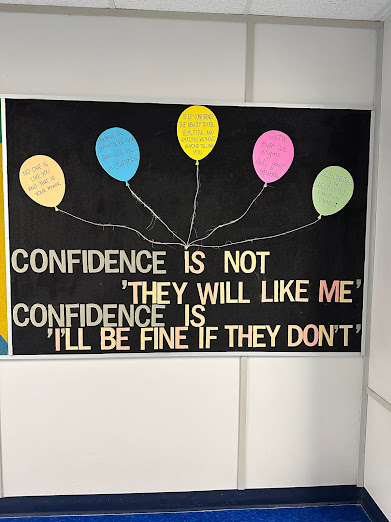
Encouraging confidence and self-belief in young individuals. The message board is located in the corridor of an Ontario school. An excellent technique to emphasize to young people that nobody should be able to undermine their confidence. Some of the motivational slogans on the board read, "No one is like you and that is your power, believe in yourself and you will be unstoppable, and Self-confidence is the best outfit. Rock it. Giving students a secure environment in which to discover their confidence is a wonderful addition to any school. 
In the hallway of a school in Ontario, there is a bulletin board that reads, "You are a star." Students can use this board to look in the mirror and remind themselves that they are valuable. You are beautiful, you are brilliant, and you are distinct are just a few of the motivational sayings on the speech bubbles that surround the mirror. To encourage children and serve as a constant reminder that they are perfect just the way they are, this is a lovely addition to any school corridor. 


Presented by: KarenB@NUO

Wednesday, September 27, 2023

EduTopia: Building a Reading Culture

 3 Ways to Build a Positive Reading Culture in Middle School

From spooky read-alouds for Halloween to a spring Battle of the Books, middle schools can use these strategies to get all students excited about literacy. 

Click the title above or the picture below.

Courtesy of Friends@NUO-2022


Tuesday, September 26, 2023

Proloquo2Go Communication App


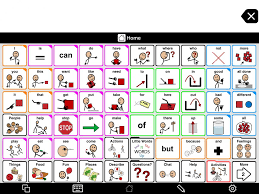
Proloquo2Go is an amazing augmentative and alternative communication app for non-verbal autistic students.  It helps students grow and minimize their frustration when trying to communicate their thoughts, wants, needs, and also helps increase their academic skills.  There are a variety of symbols students can use for daily communication.  


I have been an EA for many years and have worked with a variety of non-verbal students and would highly recommend Proloquo2Go!

Understanding Proloquo2go – Proloquo2go for autism


Proloquo2Go can be used on an iPad, iPod touch, or iPhone.  


Proloquo2Go vs Grid3 AAC - Goally Apps & Tablets for Kids

Amazing Features Prolo2Go offers:


  • Choose from 3 vocabulary levels and 23 grid sizes 

  • 4750 unique words, another 7250 pre-categorized in storage

  • Customize to user interest

  • Over 20000 symbols or use your photos

  • Move buttons, modify appearance and spacing

  • Customize vocabulary per student with multi-user support

  • Transition vocabulary levels as student's skills grow

  • Consistently located core words

  • Grammar support

  • Available in English or Spanish

  • Activity templates 

  • Word prediction in typing view

  • Share messages through mail, messages, twitter, facebook

  • Over 45 natural sounding TTS voices 

  • Pre-recorded expressions and sounds

  • Share folders between users and devices

  • Use through Apple Watch


For more information, you can visit:


https://www.assistiveware.com/products/proloquo


Not being able to speak isn’t the same as having nothing to say. Children, teens and adults who can’t speak can use this app and from the first time someone opens the app, a few taps are all it takes to start talking to the world.


Brought to you by:  AmandaL@NU

Saturday, September 23, 2023

I like Myself Story

This book "I like Myself" was written by Karen Beaumount is a great story to read to students in the primary and junior division. My class used this book  to educate the grade 1 and 2 students on the concept of self-confidence. This was an effective teaching tool to promote confidence, self- love, and acceptance in your students, it can be followed up with having your student write a  journal and creating a self- portrait. The grade 1 and 2 enjoyed listening to this story and the classroom teacher found a great read aloud for this story.


Friday, September 22, 2023

Using Vibrating Mouthing Toys in a Community ASD Classroom


One of the students I work with has been diagnosed with complex ASD and has an extreme oral fixation. We have tried many oral toys, such as chew necklaces, chewy tubes, chewable pencil toppers, etc. Unfortunately, these oral toys did not hit the stimulus input that this child required. They continued to chew textbooks, their clothing, and any item they could get tangibly. This is when we decided as a team to get a vibrating oral toy to see if this would help and provide safety for the child with the consistent mouthing of non-preferred items.


Oral-mouthing toys provide engaging and gentle stimuli for individuals with exceptionalities. It can help a child feel calmer when they need that sensory feedback or to build sensation tolerance. These toys help children to have a safe experience and give them control over the sensory input.  


These types of devices are created with the needs of children in mind, whether hyposensitivity or hypersensitivity. 


Sensory Toys can help/benefit children by:

  • Allowing for safe exploration

  • Teaching children cause and effect 

  • Helps build skills (cognitive, motor)

  • Help feel calm and relaxed - even when escalated

  • Gain focus within their environments


You can find great devices at: https://enablingdevices.com/


Tanisha@NUO


EDUTOPIA Article: Reflective Practice

6 Tips for Making Reflection a Consistent Habit


Reflecting on teaching practices and classroom events is valuable, but it can be tough to regularly make the time for it. These tips can help.


Brought to you by Friends@OTU-2023


Violence in the Classroom and Inclusion


 Almost 80% of Elementary school teachers in Ontario have been victim to or witnessed violence in the classroom. (Elementary Teachers Federation Ontario, 2023)


Does this number surprise you? It absolutely should!

A simple google search of "violence in the classroom Ontario'' results in hundreds of news articles in which teachers speak out about the violence they or are experiencing everyday in their schools and classrooms. There are many articles that discuss the extreme cases of violence where a student has attacked staff and the police were called. Recently, in Ontario we have seen an incident where a 12 year old girl was tasered by police because of a violent outburst at school. This student attacked 3 staff and 1 student which resulted in the hospitalization of 1 victim.  The overarching messaging in the media seems to be that it was unacceptable for the police to take these steps. The thing that the media doesn't see is that this child had multiple violent incidents over multiple years, beginning in JK. This student had scissors at one point and the staff and police tried every other means of de-escalation possible. If this was an 18 year old running around the streets attacking random people with scissors, sending 1 to hospital, and the police tasered them, would we as a society be as outraged as we are about this? Probably not. But other than age, where is the difference?

The fact that we have schools in our province that have locks installed on the doors so if a student becomes aggressive, the staff can leave the room and lock the student in the room alone. Hallways are shut down and 4-5 staff escort 1 student into a classroom dressed in padded "Stealth Wear" jackets, hard hats, arm guards, shin guards, face shields, gloves and many other types of Personal Protective Equipment. Students are put into contaminants on a daily basis sometimes multiple times in 1 hour. How is this EDUCATION? What are we teaching these students? What are we teaching other students that witness this or have to have their education disrupted? As a system we are failing when it comes to inclusion and whose rights do we violate. What is inclusion? It's definitely not this. 

Ontario Curriculum states "Human rights principles recognize the importance of creating a climate of understanding and mutual respect for the dignity and worth of each person, so that each person can contribute fully to the development and well-being of their community. Indeed, human rights law guarantees a person's right to equal treatment in education. It requires educators and school leaders to prevent and respond appropriately to discrimination and harassment, to create an inclusive environment, to remove barriers that limit the ability of students, and to provide accommodations, where necessary." (Government of Ontario, n.d.)

Are the students who are in multiple contaminants a day contributing fully to their well being and development? Are we really removing barriers that limit these students, or are we creating other barriers for the other 34 children in the classroom? Who's right trump who's? 

I am by no means saying these children do not deserve an education, I am simply saying that maybe their education is inclusive in a school setting specifically designed for them to succeed instead of a system where they are set up to fail. Our current system doesn't have enough supports in place for this to ever be equitable and all our children to succeed. How do we begin to fix a broken system that is truly fair and equitable for ALL kids? How do we protect our children from the traumas they are experiencing on a daily basis caused by the violence that is occurring in our classrooms? Ontario we need to do better. 


-Jill@NUO

References:2023 ETFO All-Member Violence Survey Results. (2023). Elementary Teachers Federation Ontario. Retrieved September 21, 2023, from https://www.etfo.ca/news-publications/publications/etfo-violence-survey-results


Government of Ontario. (n.d.). Human Rights, Equity, and Inclusive Education. Ontario Ministry of Education. Retrieved on September 20, 2023 from https://www.dcp.edu.gov.on.ca/en/program-planning/considerations-for-program-planning/human-rights-equity-and-inclusive-education


Added information:

Click the picture below to read more on School Violence in Ontario:


Click the picture below to watch news conference on School Violence in Ontario: