Thursday, November 23, 2023

Across Grade Levels, Should Learning Be a Lot More Playful?

 EDUTOPIA Article:

PLAY & RECESS

Across Grade Levels, Should Learning Be a Lot More Playful?

Denmark has fully embraced playful learning in its K–12 schools. We visited two schools to see the pedagogical approach in action.

Read more by clicking here >>>>> Fun Wow!

Saturday, November 18, 2023

Trauma Informed Lens

Trauma informed teaching isn't always easy, it requires a great deal of regulation from the educator and the ability to be mindful enough through various types of behaviours to understand the deeper meaning. 

When we meet children who are acting from an activated nervous system with empathy, understanding and make them feel safe we are able to co-regulate with them. The more we co-regulate and role model what that looks like, the more likely they are to demonstrate the ability to self-regulate on their own in the future. 

Here is a great little cheat sheet from Whole Hearted School Counselling (one of my favourite SEL resource go to's!) for you to keep in your back pocket that helps paint a picture of what various types of trauma responses can look like. 

I hope this resource serves you well in the important work you do everyday.


Kristen M@NUO-cohort18 

Friday, November 3, 2023

Mastering the Pace and Tone of Your Questions to Students

 EDUTOPIA article:

TEACHING STRATEGIES

Mastering the Pace and Tone of Your Questions to Students

Teaching students effectively means helping them advance through the moments of discomfort they experience when faced with challenging questions. 
Read more at: Getting Better
Courtesy of Friend@OISE

Wednesday, November 1, 2023

Diversity Corner


 Diversity Corner


In our kindergarten classroom to display diversity, equity and inclusiveness the teaching team came up with the diversity corner that changes based on the cultural relevance of the students. At the beginning of the year, we were learning about self-autonomy. 


We read the story "The Name Jar" by Yangsook Choi. Each child then went home and spoke to parents about what their names meant and put them in a jar. Each week one two students would pick from the jar one name and we would explore what that students name means and display it on the wall. 


The children enjoyed it, made them feel special and were so excited to explain how their name described who they were. 

(((Click the image to read the story)))


Courtesy of Alysha@NUO

Tuesday, October 31, 2023

Daily Affirmations

I believe in me 

I am brave

I am beautiful 

I am kind 

I am loved 

I am smart 

I am amazing 

I matter 


Children are incredible. We see it everyday as they never cease to amaze us. 

With daily affirmations we can continue to instill confidence in their greatness! 


Shona@NUO

Saturday, October 28, 2023

Creating Integrated Units - It's what teachers need to do!

 EDUTOPIA Presents:

INTEGRATED STUDIES

Designing Interdisciplinary Units in Elementary School

This eight-step framework can help teachers create units that integrate science and social studies with math and English language arts.
Want to know more? Click here >>> Integrating
Courtesy of Friends2020@NUO

Friday, October 27, 2023

Inclusion in the Classroom

PROMOTING INCLUSION IN THE CLASSROOM


When a child is included in the classroom, it means that they all have equal access to educational opportunities in a setting where all students feel secure, respected, and valued, regardless of their gender, race, religion, or ethnic heritage. In addition to actively addressing and working toward the eradication of negative stereotypes and attitudes based on gender, aptitude, learning style, race, ethnicity, or religion, or any other identifying factor, creating an inclusive classroom also entails addressing these issues. In the classroom, students who may have felt like the "other" are accepted and valued members of the community. Because it nurtures each child's sense of belonging, their sense of being seen and understood for who they are, and their intrinsic value as human beings, inclusion in the classroom is vitally important. Empowering inclusive classrooms.

HOW TO PROMOTE INCLUSION IN THE CLASSROOM IN 7 STEPS


Get to Know Your Students

Understand How Your Students Learn

Promote a Positive Learning Environment

Include A Variety of Learning Materials & Activities

Encourage Interaction Among Students

Offer Additional Support

Collaborate as a Community


Courtesy of Roya@NUO


Editor's note:
Promoting inclusion in a classroom requires providing a range of materials and activities that supports all students' learning styles, incorporates a variety of cultural backgrounds and perspectives, and fosters courageous thinking.

Wednesday, October 25, 2023

Changing our Labels

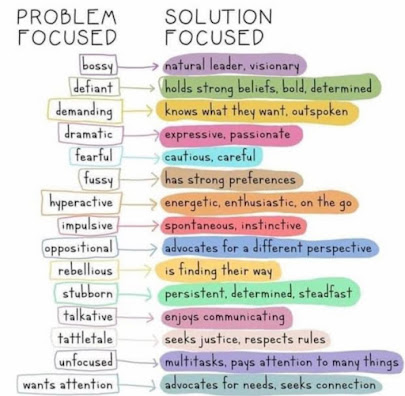
Here is a list of words that I came across at the perfect time to work on an assignment about one of my previous students. These words perfectly reflect some of the words that we may regularly use to describe a child within our care. 


By using a solution focused approach, we are showcasing the behaviours that we may find difficult to work with, in a way that positively describes the child. It is a more respectful, and impactful way to describe a child, similar to person-first language where you describe the individual before an exceptional difference.


These words are posted up in my classroom as a reminder that a child is always learning, and the words that we use to describe them can impact the view that they have of themselves.


Continue to build up the esteem of the children in your learning environments!


Courtesy of: SarahP@NUO

Saturday, October 21, 2023

Practice that Helps

 EDUTOPIA Presents:

SOCIAL & EMOTIONAL LEARNING (SEL)

A Daily Practice That Students Can Use for Self-Regulation

Knowing what makes them feel grounded can help students—and teachers—regain their calm during times of extreme stress.
Want to read more? - Click here >>>>> Practice that Helps

Amanda@OISE21

Autumn Inquiry

In my kindergarten class, many students have been visiting farms and going apple picking. This sparked some questions in our class about how apples grow, why are apples different colours or why do leaves change colour? 

As a class, we investigated these questions and did some fun activities, like reading the book "Leaf Man" and making leaf creations. We also brought in some apples for apple stamping. 


Engage with this online reading of Leaf Man


Here are 2 read-alouds about apples:
 
The Biggest Apple Ever


How Do Apples Grow (read aloud)


Here's one last book for you - The Leaf Thief


Brought to you by: NatalieK@NU

Wednesday, October 18, 2023

eSchoolNews Article: Tips for New Teachers

 5 tips I’m excited to share with first-year teachers

Julie Cobb, Senior Manager, Professional Services, Nearpod
October 6, 2023

First-year teachers may feel overwhelmed, but a few tips can help calm their anxiety.

I’ll never forget my first day as a teacher. I was so excited to begin my career teaching kindergarten students who were deaf or hard of hearing. My enthusiasm petered out when I saw green paint spilled all over my classroom. Overwhelmed and flustered, I hadn’t accounted for mishaps like this to be part of my lesson plan and was quickly faced with the realization that there were many things that happened in the classroom that weren’t accounted for in my lesson. Thankfully, one of my fellow teachers reassured me in the aftermath by saying, “You clean it up and try again tomorrow. Now you know not to put as much paint in the cup next time.”

Throughout my 26 years of teaching, I’ve heard similar accounts from other first-year teachers anxious to get their footing in their new roles, but more than anything, they wanted to connect with their students and students’ families. They wanted to avoid cleaning up spilled paint, searching for the right lessons or managing repetitive tasks that took time away from their students.

Every educator has been the new kid on the block, and I can assure you, we’ve all spilled the metaphorical and literal paint. While your day or week may not perfectly mirror the lesson plan you so diligently created, I have five key tips to help first-year teachers feel more confident in their classrooms this year, so that the little messes don’t feel so big.

1. Seek out the support of your colleagues.

I had an amazing colleague when I worked in deaf education. I could visit her room and vent everything that went wrong to her, and she’d be there to encourage me. While the teachers’ lounge may feel like a daunting place, remember that we’ve all been the new teacher in a school at some point. Leverage your colleagues, seek out their experiences and expect to hear both positive and negative stories that helped shape who they are as an educator. Not only will you gain more confidence in knowing others have been in your shoes, but you’ll also gain the perspectives of those who can remind you that with every misstep, there’s a positive that comes from your day. Finding someone who can help you find those positives is key to ensuring your success in the classroom, as well as your students.

2. Narrow down the activities you “have to do.”

Teachers ask questions and make a lot of decisions as they prepare lessons. Are they grade-level appropriate and aligned to standards? Is all of the information up-to-date and accurate? Is the material I’ve created visually engaging to my students? Suddenly, you feel like you need to choose among 22 things and don’t know where to start.

If you can find high-quality resources that answer three or four of these questions simultaneously, you’ll feel less pressure. Find resources that streamline your ability to choose engaging lessons that support your teaching. Web-based platforms with lesson libraries of high-quality, standards-aligned interactive lessons, games and activities are especially useful, as are resources that let you upload your own slides, videos and PDFs. With all your materials in one place, you can spend less time hunting for resources and ensuring their credibility, and more time doing what you love—helping your students.

3. Be open to technology that supports your teaching.

I spent five years working as a technology coach where I helped teachers integrate digital learning into their classrooms. Pre-pandemic, I met educators who weren’t open to using technology as a tool because of the fear that it may take their place in the classroom. While no technology can ever replace the impact of a teacher, technology can support educators in managing repetitive tasks and gathering evidence of learning. We discovered the value of technology during the pandemic but also learned that technology’s impact can only extend so far without a teacher’s implementation and guidance.

4. Engage your students in new and different ways.

I’ve always told teachers: Decide what you want your students to learn first, and then figure out the appropriate tool to support their instruction. Children learn and absorb information differently and therefore need a variety of ways to take in and engage with the materials you have prepared. For example, you can reinforce concepts using interactive videos, games, and quizzes. Yet, it’s challenging to create digital resources from scratch—and even more challenging to adapt them to meet the needs of each student.

Utilizing technology that is standards-aligned and provides educators with options to leverage interactive videos or other formats of material allows for greater flexibility in the classroom and less stress on the teacher.

5. It’s all about balance.

Looking back, I put too much pressure on myself as a new teacher–something I’ve seen time and time again from others in the field. I learned to permit myself to tackle today’s unfinished work tomorrow, and practiced the same level of patience and grace I gave my students, with myself.  We all want what’s best for our students, but it’s essential to remind yourself regularly—you and your students are resilient. First-year teachers should always look for their successes and celebrate them regularly.

Key points:


Brought to you by: Friends@NUO2022

Monday, October 16, 2023

Understanding and Supporting Students with Learning Disabilities: A Guide for Primary and Junior Teachers

Recently, I've had a fantastic opportunity to learn about learning disabilities, and I'd like to share my insights. Learning disabilities are processing issues that can hinder an individual's ability to learn and apply skills effectively (Woolfolk et al., 2019). While there isn't a universally agreed-upon definition for learning disabilities, it encompasses "a number of disorders which may affect the acquisition, organization, retention, understanding or use of verbal or nonverbal information" (Used with permission from Learning Disabilities Association of Canada, January 30, 2002, as cited in Woolfolk et al., 2019) and can coexist with various conditions.

According to the Learning Disabilities Association of America (n.d.), there are common types of learning disabilities, such as dyslexia, dysgraphia, dyscalculia, executive functioning issues, oral/written language disorders, specific reading comprehension deficits, non-verbal learning disabilities, and ADHD (which often co-occurs with learning disabilities). Recognizing learning disabilities early is crucial for offering timely assistance. Signs to watch for may involve challenges with reading, writing, math, organization, attention, and following instructions. Be vigilant with students who consistently struggle or show signs of frustration in the classroom.

As an Educational Assistant (EA) and Teacher Candidate, I strongly believe that inclusive education is a cornerstone of contemporary teaching. It's our duty as educators to establish an environment where every student can flourish. Among the array of students, we embrace in our classrooms, there are those with distinctive learning needs, including learning disabilities. In this blog post, we'll explore practical strategies for primary and junior teachers to provide effective support to these students.

Below are some practical strategies to assist these exceptional students. These ideas were recently learned in courses like "Teaching Students with Exceptionalities P/J" and "Human Development, Learning, and Motivation" at Niagara University, and the accompanying images were found on Google to illustrate these concepts.

·         Differentiated Instruction:

o    Tailor your teaching methods to cater to individual needs.

o    Offer multiple ways for students to demonstrate their understanding.

o    Break down complex tasks into smaller, manageable steps.

·         Multisensory Learning:

o    Incorporate various sensory modalities like visual, auditory, and kinesthetic in your lessons.

o    Use manipulatives and hands-on activities to reinforce learning.

o    Visual aids and color coding can be particularly helpful.

·         Structured Routines:

o    Establish a structured daily routine with clear schedules and expectations.

o    Provide visual schedules or checklists for students with executive functioning challenges to help them stay organized and manage their time.

·         Positive Reinforcement:

o    Celebrate small victories and acknowledge efforts.

o    Create a classroom atmosphere that promotes self-esteem and self-advocacy.

·         Assistive Technology:

o    Utilize technology, such as speech-to-text software, screen readers, or audiobooks, to help students access and comprehend content.

o    Explore apps and software designed for students with learning disabilities.

·         Individualized Education Plans (IEPs):

o    Collaborate with special education professionals to develop and implement IEPs tailored to each student's needs.

o    Monitor students' progress and make necessary adjustments to the IEP.

·         Oral and Written Language Support:

o    Offer additional time and resources for students who struggle with written expression.

o    Allow students to express themselves orally or through alternative assignments when appropriate.

·         Reading Comprehension Strategies:

o    Use graphic organizers and visual aids to help students visualize and organize information.

o    Encourage students to summarize texts in their own words to check for comprehension.

·         Non-Verbal Learning Disabilities:

o    Foster an environment that provides clear and structured communication.

o    Use social stories and visual cues to help students navigate social interactions.

·         ADHD Strategies:

o    Establish a calm and organized classroom environment.

o    Provide opportunities for movement and sensory breaks to help students with ADHD regulate their attention.

o    Encourage the use of tools like fidgets or noise-canceling headphones when necessary.

·         Peer Support:

o    Promote peer-to-peer support and understanding.

o    Encourage cooperative learning, where students work in pairs or groups to support each other.

·         Professional Development:

o    Stay informed about the latest research and best practices in teaching students with learning disabilities.

o    Attend workshops, conferences, and training programs related to inclusive education.

·         Parent Collaboration:

o    Maintain open communication with parents or guardians to discuss students' progress and challenges.

o    Collaborate with parents to create strategies for supporting students both at school and at home.

As primary and junior teachers, it's both our privilege and duty to support all students on their educational journey, including those with learning disabilities. By recognizing the signs, employing practical strategies, and maintaining a growth mindset, we can create a positive and inclusive classroom where every student has the opportunity to succeed. Since each student is unique, it's crucial to continually assess and adapt your teaching methods to meet their specific needs. Working closely with special education professionals and families, and utilizing available resources can provide valuable support for both teachers and students. Remember, a supportive teacher can be a beacon of hope and empowerment for students with learning disabilities, help them discover their full potential and achieve their dreams.

References

Woolfolk, Anita E., Winne, Philip H., & Perry, Nancy E. (2019). Educational Psychology (7th Canadian ed.): Pearson Canada Inc.

Learning Disabilities Association of America (n.d.). Types of Learning Disabilities. Retrieved October 15, 2023, from https://ldaamerica.org/types-of-learning-disabilities/

Editor's Note: Click on each image above (and below) to take you somewhere with reference to supporting students with LD

Courtesy of FernandaB@NUO