Wednesday, September 23, 2020

Kahoot in the Classroom

Anytime I have a group presentation or trying to gauge the understanding of any audience a Kahoot game is the perfect method. Classrooms across North AMerica have embraced technology and integrated it with how classrooms are run today. Kahoot has proven beneficial to the learning habits of students and helping teachers better plan lessons. A literature review of 93 cases found that classrooms that use Kahoot have positive effects on learning performance, classroom dynamics, attitudes, and anxieties (Kahoot, NA) (Link: https://kahoot.com/blog/2020/07/01/dozens-of-studies-show-learning-benefits-of-kahoot/). This was because the game-like nature fosters an exciting opportunity for students to exercise classroom engagement, participation, and motivation. What students don't like a game?


Students are able to check in with where their understanding lies after lessons and teachers can find out what students do and do not understand. It also increases students' participation by being able to keep their answers private. If they get a wrong answer there's no repercussions of a bad grade or the attention of their peers. This creates the opportunity for students to foster a growth mindset and see their "failures" as learning opportunities. It is well known that students who are actively learning by participating and getting specific feedback of where their understanding lies are more likely to understand the lesson or concepts being taught. From the fun colours and catchy theme song to the addition of smart phones or devices into the classroom, Kahoot motivates students and teachers to keep learning in a safe and fun environment. 


It will be interesting to see if Kahoot lends itself even more to an online format to encourage engagement and motivation in students. With the lack of personal interaction that is so important to a learning environment, Kahoot can at least bring in the fun to an otherwise boring format to learn.


Lauren@NU


Technology as a tool for Special Needs students: Read&Write

Read&Write is an application that can be either installed onto a computer, or downloaded as an extension on Google Chrome. What makes it a useful tool for any teacher is the fact that it can be used for both regular students, and students with special needs. It allows children to speak to a computer and types out their words (which is good for students who struggle with their fine motor skills--i.e., writing), it reads sentences, paragraphs, stories, etc. to the child (if they cannot read or have a hard time reading), and has a spell-check and grammar feature which is useful for all in the classroom.

Read&Write is an app that can help students in their daily struggles with language and literacy. It is a very useful tool for teachers as it allows them a creative opportunity to implement a students' IEP. For example, instead of the teacher scribing for a child, the computer does it for them, which allows the student to be independent in his/her learning while simultaneously learning how to use technology. Who's to say that it wouldn't be useful for us as teacher candidates as welll?

You can find the Google Chrome extension for Read&Write here

Brought to you by Giordano@NU


Jack Hartmann Kids Music Channel

Ten years on youtube, Jack Hartmann has become an icon on youtube due to his upbeat, catchy and sometimes silly songs. His love for education and teaching children through music is demonstrated through the variety of videos on his channel. Jack Hartmann has created so many songs that target important skills and knowledge for children's development. What makes these videos special? For the most part, he works alongside teachers and values their input. He listens to them and creates music based on what they feel needs to be shared in classrooms or at home to successfully support every child. He uses a variety of styles of music in order to keep children engaged and wanting to learn more. Jack Hartmann's music is more than just learning about every subject in the curriculum. It influences every area of a child's development such as having a song called "Shake Break" for gross motor skills as well as exercising the importance of giving yourself and your mind a break to breathe and relax. Another example is "I'm Just Like You" which is a song for socio-emotional skills and sharing autism awareness for a more inclusive environment. He has even developed a few songs in relation to COVID and the importance of helping one another by maintaining distance and continuously washing our hands.


I have seen many teachers use his music before starting the day or their lesson plans as well as a break in case the class has had a busy day. Jack Hartmann has music for everybody! All his songs are incredible and meaningful, and deserve a chance to be shared with children. Music is an interest for many children so what better way to engage them in learning experiences through songs that are fun to dance and sing along to.  


Paola@NU

Monday, September 21, 2020

Dealing With The Pandemic - Online Education

https://live.clickto.camp/user is an online software that is very similar to zoom but incorporates activities such as a drawing board, polls and sharing links.

Due to COVID19, students weren't able to attend school from March until recently and summer camps were cancelled. The curriculum had to be minimized and in some cases discontinued. Private schools resumed to online teaching for the higher grades, but public education systems did not, leaving students to complete the final assignments given to them in order to receive a grade for each course.

At the end of June I took part of a new youth program where I was a counsellor to 14 campers on a virtual camp. It was a week long camp that would start 9am and end at 2pm. The age groups ranged from grade 1-3, 4-5 and 6-7. As the counsellor, I was the host and therefore in control of ClickToCamp. There was an option to pin the videos of the campers, create polls or questions of truth or dare, share my screen or links to videos as well as a drawing board where my campers and I would normally play hangman. Everyday, my group would have a different schedule where there was an activity such as "sports" or "arts and crafts". I would move my entire group from one online room to another where a specialist (similar to a gym teacher) was ready to present a sports related game. For example, there was a wheel created where every camper in their turn got to spin it and the first one to complete the task (10 jumping jacks, 5 burpees or 15 second plank) won points.

An example of a game that I played online was that I would put everyones camera on the main screen and I would call out different household objects that the campers would have to go and find and then prove to the rest of the group that they found it. The ones who found the objects first won.
                                   
I also started off each day with a song that I played in the background for only a few seconds and the group had to guess the name of it. The ones to guess correctly received points!

The best part about this program was seeing how happy the campers were to wake up early and go on ClickToCamp just to see me and the other kids. They were lacking the social aspect of school and creating new friendships, so this program was a great benefit to their time in quarantine.

Danielle@NU

Streaming within the Education System

I started to see math as a challenge in grade 6. Up until then, I had always done fairly well and didn't have to work particularly hard to achieve a good grade. In grade 7 and 8 I still managed, but I had to work a lot harder. When I got to grade 9, I immediately found the content significantly more challenging. I struggled right away, and I failed the first unit test… badly. I was shocked, as I have never failed anything up until that point. Within a couple of days of receiving that result, my parents received a phone call informing them that there were only a few places left in grade 9 applied math and they were encouraging them to transfer me from academic to applied math. My parents are both educators and decided to go along with the school's suggestion to transfer me to applied, because they didn't want all my marks to drop because I was spending so much of my time working on math. 

Over the next few years, I achieved success in senior high school math credits and even university math credits. It wasn't easy, I didn't do fantastic, but I survived. I was able to use all learning skills to find success. In the last couple of years, the province and the TDSB seems to be moving away from the idea of grade 9 streamed subjects. My teacher labeled me right away as a weak math student. I think this idea of streamed subjects should be eliminated because categorizing students with labels such as applied can hinder one's success. 

If the child is in applied level classes and is subtly reminded that they are part of the lower stream, that is going to diminish their self-esteem and confidence. Additionally, there is an equity issue involved with streaming. When the school suggests that a child should go down to a lower level, some parents and communities are less able to push back and advocate for their child to help them be successful in the academic class. The parents may just listen to the school and then the kid moves to applied and shuts the door to university. Ultimately, I believe that moving away from streamed subjects will create a more inclusive school environment.

Here is an article that the Star posted in 2018, stating that the TDSB wants to move away from streaming.


https://www.thestar.com/yourtoronto/education/2018/01/28/tdsb-head-wants-to-phase-out-streaming-expand-access-to-specialty-schools.html


Kyra@NU

Intrinsic vs. Extrinsic Motivation with Students

Motivating students, both inside and out of the classroom can sometimes be overwhelming, as it can take many aspects for a student to be engaged and actively participating. Based on this week's learning key on fragile interest, intrinsic and extrinsic motivation were discussed. Intrinsic, which are things that are within you that make you want to do things, while extrinsic, are things that are outside of you to artificially get you to do things. It is important as a teacher candidate, to have strategies on how to sustain student's interests, rewards and how to engage them throughout their learning.


I found an article, that discusses classroom ideas and is beneficial to both teachers and teacher candidates. It discusses an understanding of having intrinsic and extrinsic motivations inside the classroom, available to all students. If students are not engaged, they are not motivated and not learning anything. Growing up, if I found myself spaced out or daydreaming, it was because I wasn't intrigued or engaged in what was in front of me. Although not everything will be engaging for students in life, it is important to find ways to motivate them and inspire them to want to engage in their learning. I remember in grade 7, I had a teacher that would have different concepts every single for students to be engaged, which resulted in me loving to learn with her in the classroom, as it was a fun learning experience.

The article also discusses that it is important that there is a right balance, children might get overwhelmed with too many extrinsic motivations or vice versa, so it is important to know how students are motivated, in their own individual way. In order to do so, it is important to truly know your students and their individual needs. By doing so, you are not only able to motivate them, but make accommodations and modifications for them, based on what is being presented to them. Students are always curious, so it is engaging to use their interest and inquiries and adapt them to their learning and lesson plans. This can result in them making connections and wanting to be active participants in their learning in a very powerful way.


There are many tips and tricks that teachers can use in the classroom to motivate their students. This website shows great ideas and explains each in full detail!


https://www.weareteachers.com/understanding-intrinsic-vs-extrinsic-motivation-in-the-classroom/


Courtesy of Sofia@NU

Sunday, September 20, 2020

Queer Kid Stuff (and so much more!)

Teaching students about big topics can feel difficult and uncomfortable for many educators. Lindz Armor, the creator of the web series, Queer Kid Stuff, aims to explain queer topics through vlog-focused conversations for young viewers. With a lens on love and family, each short video is a tool for parents, teachers and LGBTQ+ adults to explore these topics with compassion and understanding. 

Talking to kids about these topics is crucial. As educators, it is our responsibility to foster a safe space where these conversations can thrive and develop. It is crucial that our students feel safe to talk about gender identity in our classrooms, because the exposure to diversity and inclusion is vital to their emotional and social development. With the support of Queer Kid Stuff, teachers can leverage this webseries with an aim to simplify and hone in on the core concepts of gender identity. With the help from Lindz' co-host & stuffed teddy bear, they explore the LGBTQ+ community, activism, gender pronouns, and body positivity. Through songs, simple definitions, and metaphors, Queer Kid Stuff approaches these ideas to get down at "toddler height," by explaining the world through their tiny curious eyes. 

This is a fantastic tool for teachers to lean on when exploring these big topics in the classroom. Through their vast library of podcasts, sing-a-longs, popsicle puppet series, and read-a-louds, teachers are encouraged to bring Lindz's talks to the classroom through accessible, short, and meaningful media.  Educators can also participate in a remote learning workshop, access Queer Kid Stuff Classroom tips and/or purchase original LGBTQ+ lesson plans to help promote and create an inclusive classroom for students. 

This is more than just a webseries. Queer Kid Stuff is the sliding door toward a future generation of inclusivity, diversity, and equity. 


Raquel@NU

Movement Dance Breaks for the Classroom

https://www.youtube.com/watch?v=OPLWyZMRNn0

This link is for a YouTube video for a song Pop See Ko. This video can be used to provide children with a movement break in the classroom, if they have not been able to have that or need one. At previous placements the children loved to dance to this song and they all knew the words. \

This video can be projected onto the board or SmartBoard to allow the children to follow along. The dancers/singers in the video provide the children with a variety of dance moves to copy that are also easy to do. This video allows children to have that movement break as well as have fun as a class while participating. This song is catchy and will possibly have the children singing it once the video is done. 

The YouTube channel that posted this video also has a variety of other children appropriate songs that can allow children to have those required movement breaks. 


Courtesy of Laura @ NU

Mental Health Exercise for the Classroom


This is a link for a youtube video that involves an exercise called Rainbow Breathing. It is important to promote positive mental health in children, as well as, provide them with opportunities to focus on their mental health. This video was used by a teacher at one of my placements in a primary classroom. This video allowed the children to have four minutes for a moment of meditation or silence. They also seemed to enjoy the directions that the video gave them and they were easy for them to follow. The children liked moving their arms in the shape of a rainbow and for those children that kept their eyes open during the meditation they were able to see the rainbow moving on the screen, the way their hands should have been moving, which they also liked. Along with this video there are also a variety of others from this Youtube channel that provides a variety of meditation depending on what the teacher feels is necessary for the classroom environment. 


Courtesy of Laura@NU

Wednesday, September 16, 2020

Kahoot for You

Kahoot is a digital online educational tool.  Since today's society is highly driven by technology this could be a great way to get children involved in the class learning.  This could be an additional fun way to supplement the curriculum.  This game is used by the teacher, they would create an account and then create questions for the students to answer.  All the questions are multiple choice, and all the students would play at the same time.  This can also encourage children to take part and be competitive with one another.  Kahoot is a game-based learning tool. It is easy to create, share, and have trivia quizzes in minutes. 

Since Kahoot is a digital tool I believe it would be better used by junior/intermediate students. They would more than likely be familiar with the use of devices, as well they are more likely to have a device available for use. Kahoot could be a great activity to use for today's digital learning.  Many children and adults are learning online now, and this game is a wonderful way to get everyone involved and participating in the class. 

Below are YouTube videos on how to set it up as an educator and how to use it in the classroom.

How to use Kahoot in the classroom Video:

https://www.youtube.com/watch?v=BJ3Er1-tCMc

How to create a Kahoot Video:

https://www.youtube.com/watch?v=KJgZZQcsSPk


Courtesy of Laila@NU

Nearpod

Today, I would like to share Nearpod.  Nearpod can be used as an "Add-On" to Google Slides, or you can create your own lesson directly from it. 

Furthermore, it is intended to be for online learning, and can also be used in environments that accept / provide electronic devices. 
Nearpod allows you to create multiple activities to engage students in the online environment. Highlights I currently use and enjoy include the "Time to Climb", matching game, and drawing function. You can also take paragraphs and omit words, sending them to a word bank. Students would have to demonstrate understanding of a text by choosing a correct word. 

There are quite a few YouTube tutorials on how to use Nearpod, but I particularly enjoy Laney Goff's contributions. 

You'll wonder how you taught without it ... make every lesson interactive!

Visit:  https://nearpod.com/

Enjoy! 
Carrie@NU

Theories on Learning

Coming from a background in Early Childhood Education, one of the biggest points put forth was to always build learning upon the interests of the children. Children learn more willingly and eagerly when the topic is of interest to them. By building upon and furthering learning through the interests of the children, educators are also showing interest in the children's learning, as opposed to guiding the learning of the children. 

Grasping the interest of children and struggling to keep them engaged in a subject that they have little to no interest in is difficult, especially throughout the Primary years of school. Though through observing, listening and questioning, educators have the opportunity to discover the interests of the children and to create learning opportunities through these interests. 


Teachers have a great opportunity to form the minds of their students, by building upon their interests and furthering their engagement and concentration in their learning. 


Brought to you by: Michelle P@NU

Tuesday, September 15, 2020

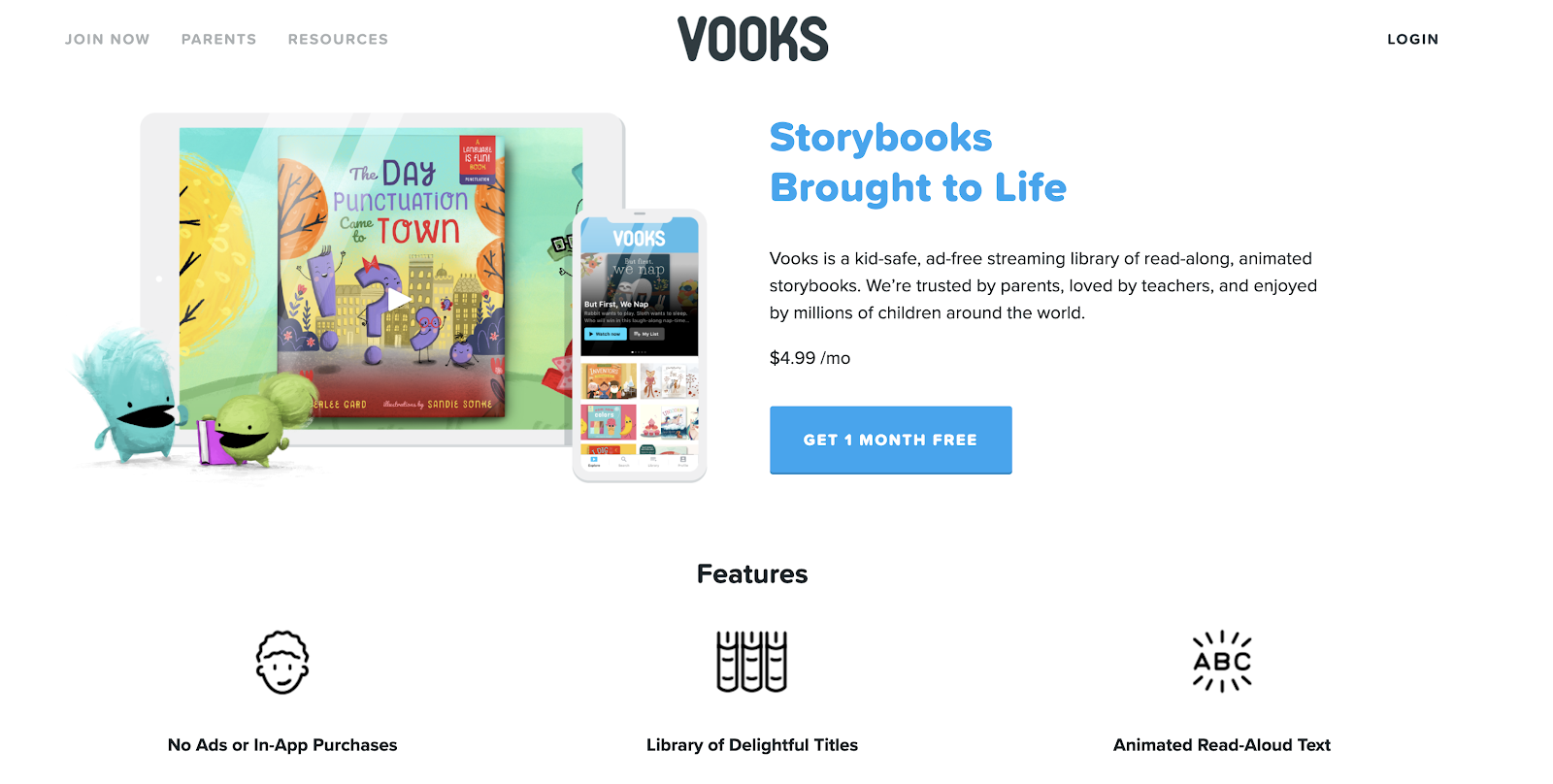
Vooks - Story Books Brought to Life

I choose Vooks to share in this blog because I believed that read stories with our children is help children gain more vocabulary, gain more reading skill, and concept necessary for reading. Children learn that texts give the reader cues to read and the picture or the animation on the page match with certain words, that pictures/animation supports the story. Reading out loud can have a great impact on a child's development and literacy.

Storytime is a great way to connect with your children/students over the timeless combination of  story and illustration, and to guide the student's understanding of the world. Vooks is an online children friendly content, ad-free streaming library for reading, animated storybooks which children really like. Vooks is provided with a model of fluent, expressive narration with effective reading aloud story time. It is the first storybook streaming service for children that makes learning to read fun! Ages 2 - 8. Vooks's books are animated with purposeful space to help maintain attention in a positive way that promotes a love of reading and a lifelong impact. Vooks's storybooks encourage parents or teachers to discuss the books they're reading on Vooks with their children/student, and Vooks even provide lesson plans for some of their books with activities to enhance the conversation. This is very good for us as a teacher to use and read with our students everyday.

Vooks also provide lesson plans which are a great resource for teachers who want to teach children to do more than just read. For example, the lesson plan provides themes, summaries, talking points, discussion ideas, activity ideas and even vocab cards.


https://www.vooks.com/?gclid=CjwKCAjwzIH7BRAbEiwAoDxxTooeJrI3hQHcEgJ6t3m-pouTL2gZUAUrJsnuomojWsYkc2w0ZLfJahoCSL8QAvD_BwE


Brought to you by: Chi N @ NU EDU436-OTECA


"Blue Eyes/Brown Eyes Exercise"

My blog post is regarding Culture & Diversity, I am using the "Blue Eyes/Brown Eyes Exercise" from Jane Elliot who has been teaching this exercise since 1968.

I have included an interview she recently had with Jimmy Fallon; she first taught this lesson on April 5th, 1968. The day after Martin Luther King, Jr was killed.

She wanted to teach something to her students as a result of his killing. No other teachers in her school did anything to talk to their students. She taught this "Blue Eyes/Brown Eyes Exercise". She divided the class between brown eyed people and blue eyed (or any other non-brown eyed) people.

https://www.youtube.com/watch?v=f2z-ahJ4uws

She said, if she had known how it would work, she probably wouldn't have done it. She lost all her friends, no teacher would speak to her, her parents lost their business. Her children were spit on, their belongings destroyed, they were mentally and physically abused by their peers, their teachers, and the parents of their peers. Teachers she spoke to that day in April didn't understand why she was teaching it. They didn't care about addressing the issue.

She has been teaching this for over 50 years.

Generations of teachers have taught this in classrooms, as noted by NPR. Think of all the people that she helped see racism and bigotry and changed their ways, or learned early that discrimination is wrong. The great impact that Jane Elliot has had on the world and teaching.

https://www.npr.org/sections/live-updates-protests-for-racial-justice/2020/07/08/888846330/we-are-repeating-discrimination-experiment-every-day-educator-says

How can we as teachers follow the lesson that Jane has set out over the last 50 years?

What can we do as teachers to help our students understand that our differences are ok and to make an inclusive classroom for all? This exercise is one way.

Nicole@NU

Mindfulness and Well-being in the Classroom

Low-level disruption, burnout, anxiety, absence and mental health problems affecting staff and students alike are on the rise. In the last seven months we have seen the rise and fall of COVID19 cases, some have lost loved ones or have known people who have experienced the virus, the injustice and lack of equality around the world .With all that is happening in the world, it is safe to say that we are all feeling some type of stress. How are we dealing with it? How are our students feeling? How can educators support students who may be feeling uneasy in the classroom? I believe the answer is simple: let's prepare students and staff with the knowledge and skills to be in charge of their own wellbeing.


I, myself believe that mental health in the classroom environment should be taken seriously and teachers should also dedicate even a small portion of their day checking in on their students or even having them participate in a five minute activity. There are countless resources available to help educators integrate mindfulness into their classrooms. As an Early Childhood Educator, when working in Kindergarten; my colleague and I always made sure that we checked in with each student in the morning and afternoon. We wanted to create a safe environment for our students to share how they were feeling and to support them to the best of our ability. One of the resources we used quite often was the 'Zones of Regulation' as it encouraged students to start using language that expressed to not only us but to their peers on how they were feeling. Checking in on our students, participating in activities as a class, validating that their mental well-being is important will encourage and support students to understand that their educators care. 


Here are some stories that you can keep in mind when talking to students about mindfulness and well-being.       

By Sarah OTECC

Monday, September 14, 2020

Importance of learning styles in the classroom

Learning Styles
As someone who aspires to be a kindergarten teacher one day, I realize the importance of recognizing the different styles of learning when it comes to child development. Each child coming into the classroom is going to be different, in the sense that not one child learns in the same way. In kindergarten, where this is the start of their educational journey, it is especially important as their teacher to understand that not all the kids in the classroom have the same learning style. 
In the past, around 40 to 50 years ago, teachers weren't aware of these differences (learning styles) and schools and classrooms were designed in a way that conformed to the teacher's way of learning. For example, if the teacher was a verbal learner who liked to read and write he/she would assume that everyone else was and that is how he/she would teach. In that situation the children who were also verbal (linguistic) learners like the teacher did well, and the other children who had different learning styles did poorly. 

As future educators it is important that we get to know our students and their specific learning styles so that we can adapt our teaching to meet their needs and set up our classroom environments in a way that is suitable and encompasses all learning styles.  


Sarah@NU-OTECA

Sunday, September 13, 2020

Cognitive Development

Exposure = Connections = Learning

With a background in Early Childhood Education and Child Development, I understand the importance of early exposure and setting the appropriate foundations in order for a child to grow and develop to the best of their abilities; the more exposure the brain gets at an early age, the more connections will be made which set the stage for optimal learning. 

As educators in the Primary/Junior Division, we are going to be teaching children in the most important years of their life. This is why we need to be mindful, patient, caring, and educated on providing children with stimuli that will be beneficial to their learning. Creating a classroom that is bright, warm, welcoming, and inclusive to all children's needs will construct the path for success! 
Cassandra @NU

Saturday, September 12, 2020

The Digital Teacher


I believe that different forms of technologies and interactive digital games can support and enhance students' academic development. When I think back to my time in elementary school the technology incorporated in my learning was very limited. Educators are committed to promote a learning environment that fosters creativity, problem solving and collaborative skills.

How about in a virtual world though? Can computer games support these skills? 

Teachers strive to incorporate different forms of technology and digital tools within their teaching practices, it is evident nowadays to see these forms of technologies being used within classroom environments i.e., iPads, chrome books and smart boards. Despite the increased access in these digital tools, I have yet to come across a class where they participate in a collaborative and interactive virtual game. As students continue to have access to these technological devices in the classroom, they will also have more options to play different educational games. I remember enjoying some of the computer games I played in elementary school but, I don't recall any of them ever being interactive, collaborative or meaningful.

Minecraft for example, is a game that allows players to create a world where they can explore, craft, build, and create anything they want using 3D blocks. The game allows for single-player and multiplayer options. Multiplayer allows gamers to collaborate, problem solve and work together in the same world to create anything imaginable. This game is also open-ended which allows gamers to make their own choices which I think positively support students' development. Minecraft offers an Education Edition which educators can use as a teaching tool in their own classroom learning. The education edition offers resources and lesson plan ideas in different curricular areas (i.e., math, science, art and language). After playing Minecraft myself, I really enjoyed the creative and imaginative elements the game offers. As a future educator, incorporating Minecraft in my own teaching practices is something new that I would like to try. Including more virtual, collaborative and interactive games I think can empower and motivate students to step outside their comfort zone and create meaningful learning experiences.

Brought to you by: Danuiella@NU

Thursday, September 10, 2020

Confidence - It will take you places

As discussed in this week's class, confidence and competence play a huge role in the classroom as well as a child's overall success. I believe that self-confidence or lack thereof, can make or break one's success. It is critical for a student to feel safe and comfortable in the classroom. It's good to make mistakes, ask questions or admit you don't know something because that is how you learn. 

When volunteering with a grade one class, there was one student who was always smiling, laughing and was engaged in almost every subject. The moment it was time to do independent reading he would act out, distract other students or refuse to read. I realized that this student had the lowest reading level in the class and it was not because he wasn't smart enough but because he lacked confidence in himself. He was not comfortable reading or writing and so this challenge became even more daunting. As other students progressed in their reading, he did not do so as quickly and so he became even more discouraged and became more disruptive. After a couple of days of working with him privately, I realized that when he was feeling confident (maybe because he had excelled in the subject prior to literacy or was having a good day) he was not only more willing to read and learn but was also doing so a faster rate than normal. 

As he began to feel more comfortable with me and in our reading space, his confidence grew and he gradually improved more and more. Building confidence and promoting hard work is more beneficial than praising fixed intelligence or competence because it allows children to better handle new challenges and encourages growth whereas the latter, instills a value system based on abilities which can be discouraging when children find a task they cannot do.

Keegan@NU

Children’s Interests

I think including children's interests is something that is extremely important throughout a classroom. Making sure a child is included and feels he/she is a part of all areas of the classroom can make a positive impact on a child's learning. Sometimes a teacher we may not realize that we have focused more on what the curriculum is and have forgotten to focus on what the child is interested in and how that can be incorporated into the curriculum to keep them engaged and interested in what they are learning.


I think by keeping a child's interest it can give the child a sense of belonging in the classroom which may allow them to learn better and participate more since they have a connection to that is being learned. 


Through this like you can learn more

https://study.com/academy/lesson/using-childrens-interests-experiences-to-promote-learning.html


Gurleen@NU

Wednesday, September 9, 2020

Curiscope - Augmented Reality Products & Teaching Tools

I taught a science summer camp to a group of students aged 2 -10 this past month with the sole direction of getting them excited about science. While researching for a lesson I was planning on the digestive system, I stumbled across this great augmented reality t-shirt by Curiscope. 

The Virtuali-tee is a shirt that when scanned by their associated app enables a 3D, interactive rendering of the interiors of the human body - with a narrative aid! The students can explore the human body... on their own human body! It will even sync up the image with your own live heart beat. It gets even better. The product was created by a collaboration of teachers and includes full teacher resources! They have some other "multiverse" posters that would be a great addition to any classroom. 

This gift is definitive on my Christmas wish list! 

You can find out more about it at https://www.curiscope.com/


Here's a photo of one of the munchkins demonstrating the Virtuali-tee app.

Sabrina@NU

Growth Mindset - The Real World


This blog post is a video which explains how each individual has a growth mind-set by training your brain to get smarter. It gives real world examples of people who started with nothing and ended up becoming one of the biggest influencers simply by having a growth mind-set. 

This video could be used in the beginning of a school year because it encourages children to be inspired and not give up!
What Is A Success Mindset? - Acquirent
                                                                                                                                                  
Courtesy of Ema@NU

Monday, September 7, 2020

The Importance of Outdoor Learning

While exploring nature's finest, on my hike today I had to stop and take a deep breath. Have you ever done that? The exhilaration of the fresh air hitting your lungs and awakening your senses. As adults we try our very best in making sure we spend at least one part of our day outdoors, whether it's just sitting enjoying a coffee or going on a short walk. Have we ever wondered how children take in the outdoors? How important is outdoor learning for children? How can it benefit a child as whole? What do they take in from the outdoors?


Working as an Early Childhood Educator, I know the importance of outdoor education and how it can benefit students and their learning. To support educators and their knowledge of outdoor learning, there are countless resources readily available. I recently came across the resource, 'The Big Book of Nature Activities' by Drew Monkman & Jacob Rodenburg. This resource provides opportunities for educators to think outside the classroom, how they can scaffold children outdoors and how they can take in the world around them. Educators can have the opportunity to encourage children to not only use natural materials but to also use technology to capture their findings outdoors. 


Let's help children expand their environmental footprint. 

"Take one child. Place outdoors in nearby green spaces. Leave for several hours at a time. Repeat daily. Sprinkle in a dash of adventure. 

Fold in a generous portion of exploration and discovery. Top with wonder and awe. Let rise…"

  • D. Monkman & J. Rodenburg

Brought to you by Sarah @NU-OTECC

Sunday, September 6, 2020

Have fun and Improve your reading with Reading Bear

Reading Bear


Reading Bear is an online resource for children to learn phonics and expand their vocabulary. The website will demonstrate how to pronounce various sounds, for example, short a, by providing words, pictures and sentences. 


To further develop the child's understanding, the system also provides rhyming words in a similar fashion to aid in forming connections. 


Finally, quizzes can be taken to demonstrate learning and form a review of the words and sounds learned through the modules.


Engaging students in online learning has proven to be a challenge for many teachers. With websites such as Reading Bear, students are provided with an opportunity to learn and improve their reading skills while having fun online. As some students prepare for a virtual school year, websites such as these are a great tool for achieving their reading goals.


This website is currently free to use and can be found at the following link: https://www.readingbear.org


Brought to you by Alyssa@NU


Friday, September 4, 2020

Extra Curricular Activities

Ontario schools provide students with an abundance of extra curricular school activities in which they could choose to be a part of, this includes but is not limited to, social groups, sports teams, and clubs. In addition, extra curricular activities can include outside school activities as, such as community activities, volunteering, and local clubs/sports teams. Extra curricular activities are very impactful to one's journey of life. These activities keep you busy, disciplined, and give you productive breaks. They can improve academic performance, create social opportunities and even essential life skills.

Participating in extracurricular activities, allowed me to meet teachers that turned into my mentors; teachers who taught in the classroom and coached on the court. I was able to meet teammates both in school and outside of school, who became good friends of mine and contributed to my social realm. You are never too young, or too old to get involved. The positive impact extra curricular activities have on an individual's life, remain with them forever. They inhabit skills that are transferable to many life experiences, and help build passion and leadership which are instrumental to happiness and success.

As I got older, I found it much more interesting how my extra curricular activities were looked at sometimes even more than my academics and qualifications. For example, my volunteer work was instrumental in landing a job with the police. For that reason, I found this YouTube video very informative, and interesting.
Take a look…  


How admission officers view extracurricular activities: https://www.youtube.com/watch?v=MVHy_hbKSa4
Not only would this video apply to admission officers, but also future career employers. 

Megan2@NU

The Importance of Self Esteem

Self esteem is not something that can be handed to an individual, yet something that can be facilitated. This facilitation ensures that challenges are something that enhance one's self-esteem as opposed to threatening their ego. Although this is often found in a classroom environment, self esteem is something that can be affected by outside factors, such as hobbies, feedback from a guardian, and etc.

Below is a picture of me after a soccer game when I was about 8 years old. In this photo, I was being given constructive criticism regarding the game I just played. 10 years later, I received multiple full ride soccer scholarships to D1 universities, and attended East Carolina University for my undergrad. I found that I was fortunate enough to grow up with coaches who were able to instill confidence in me at a young age through their ability to praise and criticize me.
In return, I was able to challenge myself in new situations, and strive to learn more about the game and my play in order to better myself.
I strongly believe that a child's self esteem is stemmed from effort praise, strategy praise and criticism, both inside and outside of the classroom.
Megan1@NU


Tuesday, April 28, 2020

ABCya App

The reason to why I choose the ABCya app is because it is a fun and educational app for students to use within classroom settings. The app is made up of various literacy games in order for children to build on their literacy skills. As well, the grade level that this can be used for are from kindergarten to grade 6. Personally I think that this would be a useful app to implement because instead of having to always use worksheets, students would be able to learn these skills through an interactive game.

Reference: https://www.commonsensemedia.org/website-reviews/abcya

Niagara University- Yasmin Piacenza


Sunday, April 26, 2020

I started this Facebook page called: Learning Continuity Grades K-8 for parents and children in my community.  It's a page that houses ideas for continued learning at home, give it a look and give it a like! 

angie@nu